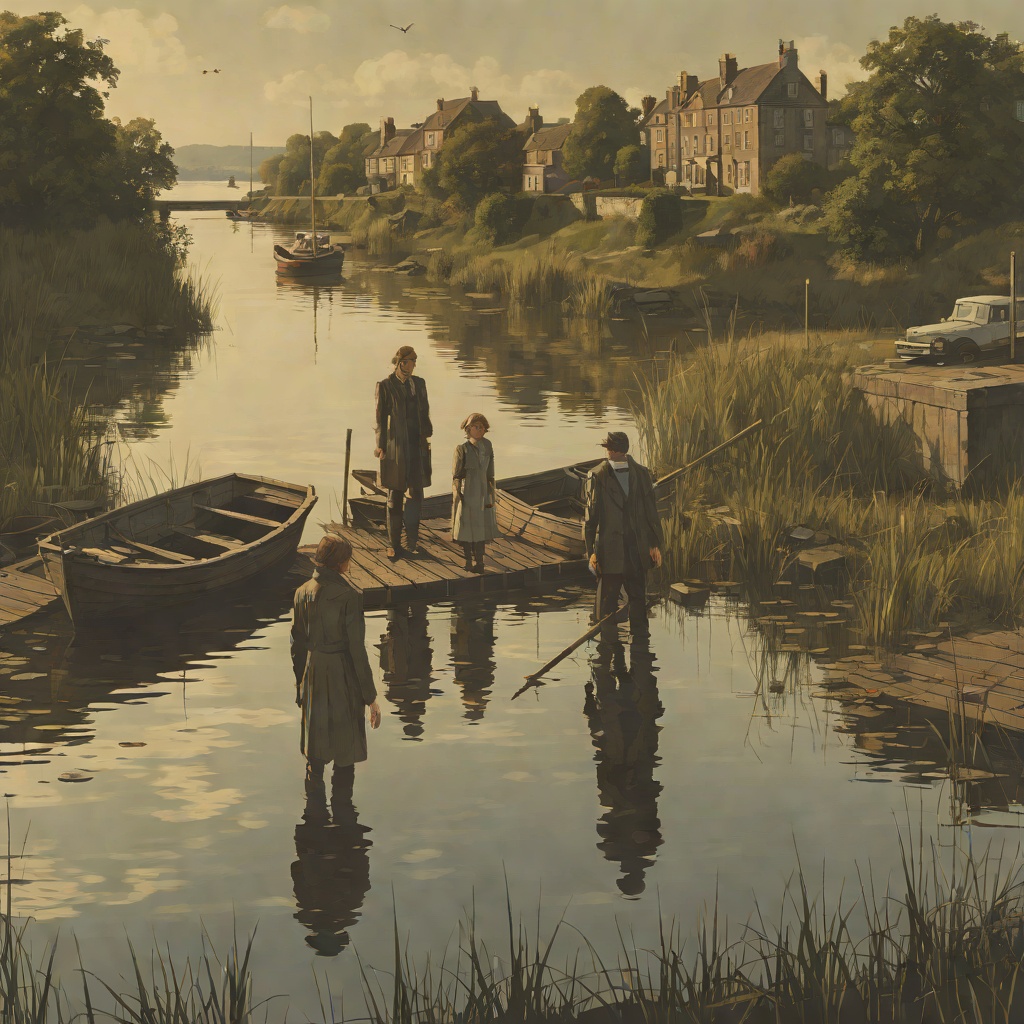
Discovery of the Lady in the Lake
Lady in the LakeThe Discovery of the Lady in the Lake is the event that turns a routine civic complaint into a murder investigation and gives Cleo Sherwood her enduring nickname. When a worker finds the body of a Negro woman in the fountain at Druid Hill Park, the discovery collides with a letter Maddie Schwartz had forwarded to the Department of Public Works about the fountain's broken lights, pulling the classified-ad clerk into a police inquiry she never sought. The body, later identified as Cleo Sherwood, a cocktail waitress from the Flamingo Club, becomes the case that Maddie adopts as her own, and the nickname the medical examiner coins — "Lady in the Lake" — is one she deliberately embraces, believing it could humanize Cleo's story the way "Tic-Tac-Toe Killer" granted dignity to his victims.
The Circumstances of the Discovery
The discovery comes about through an unlikely chain of small events. An electrician in a rowboat is about to provide the answer to a question Maddie has been turning over: what can one do with the four and a half hours each day that her boss, Don Heath, allows her to use as she wishes. Maddie had earlier opened letters that had accumulated while she was sent to the police station, and among them was a handwritten complaint, in a masculine hand, about the lights no longer working at the fountain in Druid Hill Park. She judged it something she could handle herself and called the Department of Public Works to report the outage, proud of the initiative she showed in making such distinctions. That call is what brings the police to The Baltimore Star. Mr. Marshall, the newspaper's lawyer, tells her that a worker has found a body there, a Negro woman, and the police want to know why she called and what she can tell them about the person who inquired about the lights. Maddie tries to recall every detail of the letter: it was handwritten, in a masculine hand, and the name on it struck her as false — not John Smith, but similarly generic. She had not checked the name because the letter was not running in the paper, so there was no need to verify the sender.
The Police Investigation and the Body
The detectives who come to the newsroom are guarded about what they know. When Mr. Marshall asks whether they have any idea whose body it is, the cause of death, or how it got there, they reply only that the body is in pretty bad shape and that it is a Negro woman, refusing to say more for now. Maddie reads the standoff clearly: they are not telling everything they know, so the newspaper is not telling everything it knows. She reflects that grown men can be sullen and grumpy, still playing by sandlot rules, obsessed with fairness and stature, while women learn early to surrender any idea that life is a series of fair exchanges. Mr. Marshall dismisses her as if she were of no importance to the meeting, and she feels like an instrument, no different from a typewriter or her telephone headset. She slices open that day's mail, seething at how many larger crimes might lurk in the city's petty complaints. The city editor, Harper, is dismissive of the case's news value, saying he would not even lead the metro section with a dead Negro woman in a fountain. He notes that John Diller hears it is probably a woman who disappeared earlier this year, a cocktail waitress from the Flamingo, Shell Gordon's joint, and that The Afro-American has been all over it but there does not seem to be any real news there.
Identifying Cleo Sherwood
Maddie's pursuit of the case leads her to the medical examiner, who introduces her to the body with the nickname that will stick. When Diller introduces her as Marjorie Schwartz, she corrects him — "Madeline" — and says she had hoped to talk about Cleo Sherwood. The medical examiner responds, "Oh right, the Lady in the Lake," and Maddie makes a mental note, liking the nickname and thinking that using the term might humanize Cleo's story the way "Tic-Tac-Toe Killer" granted dignity to his victims. The ME takes her to the bank of drawers and begins banging them open haphazardly, as if he does not know where Cleo's corpse might be. Maddie sees a man with stab wounds, several unremarkable corpses, and finally the one she has come for. Her stomach churns, but she maintains her composure. What she sees is barely a face, and the color is neither white nor brown but a mottled gray. The condition of the body confirms how long it had been in the water and how badly it had deteriorated.
The Significance of the Discovery
The discovery of the Lady in the Lake is the event that transforms Maddie Schwartz from a classified-ad clerk into something like a reporter, giving her a case to pursue with an intensity that surprises even her. The body in the fountain is not just a crime; it is a story that the city's newspapers, including her own, are willing to dismiss as having no real news. The Afro-American has covered it, but the white press treats a dead Negro woman as a minor matter. Maddie's decision to keep pursuing the case, to visit the morgue and face the mottled gray face, marks a turning point in her own trajectory. The nickname she adopts — Lady in the Lake — becomes the lens through which Cleo Sherwood's story is told, and Maddie's investigation will eventually uncover the ermine stole that Cleo's mother believed had great meaning to her, a very fine piece of clothing that raises the question of how any young, single woman came to have a fur. The discovery also connects to the broader world of the novel: the case unfolds against the backdrop of 1966 Baltimore, a city of changing neighborhoods and racial tension, where a Negro woman's death can be dismissed as not worth leading the metro section. The event is grounded in the novel's historical texture, with the author's note acknowledging that the two murders at the center of the book are inspired by two cases from 1969, and that the gubernatorial race in Maryland in 1966 is represented accurately, down to the weather on the day after the primary.